

Multi-tenant data centers are designed to support flexibility.
But flexibility creates complexity.
Each tenant may have different power densities, equipment layouts, redundancy requirements, and expansion timelines. Even when the building shell stays the same, the electrical systems inside it rarely do.
This is where data center electrical design becomes difficult to maintain through traditional BIM workflows.
Because the challenge is no longer just designing infrastructure.
It is coordinating constantly evolving electrical requirements within shared systems.
Why Multi-Tenant Data Centers Create Unique BIM Problems
In a standard project, electrical systems usually support one operational strategy.
Multi-tenant environments are different.
Each tenant may require:
- Separate power distribution paths
- Unique redundancy configurations
- Independent equipment layouts
- Phased deployment schedules
- Isolated maintenance strategies
At the same time, these tenants still depend on shared infrastructure.
This creates coordination pressure that many BIM workflows struggle to manage.
The Problem with Shared Infrastructure
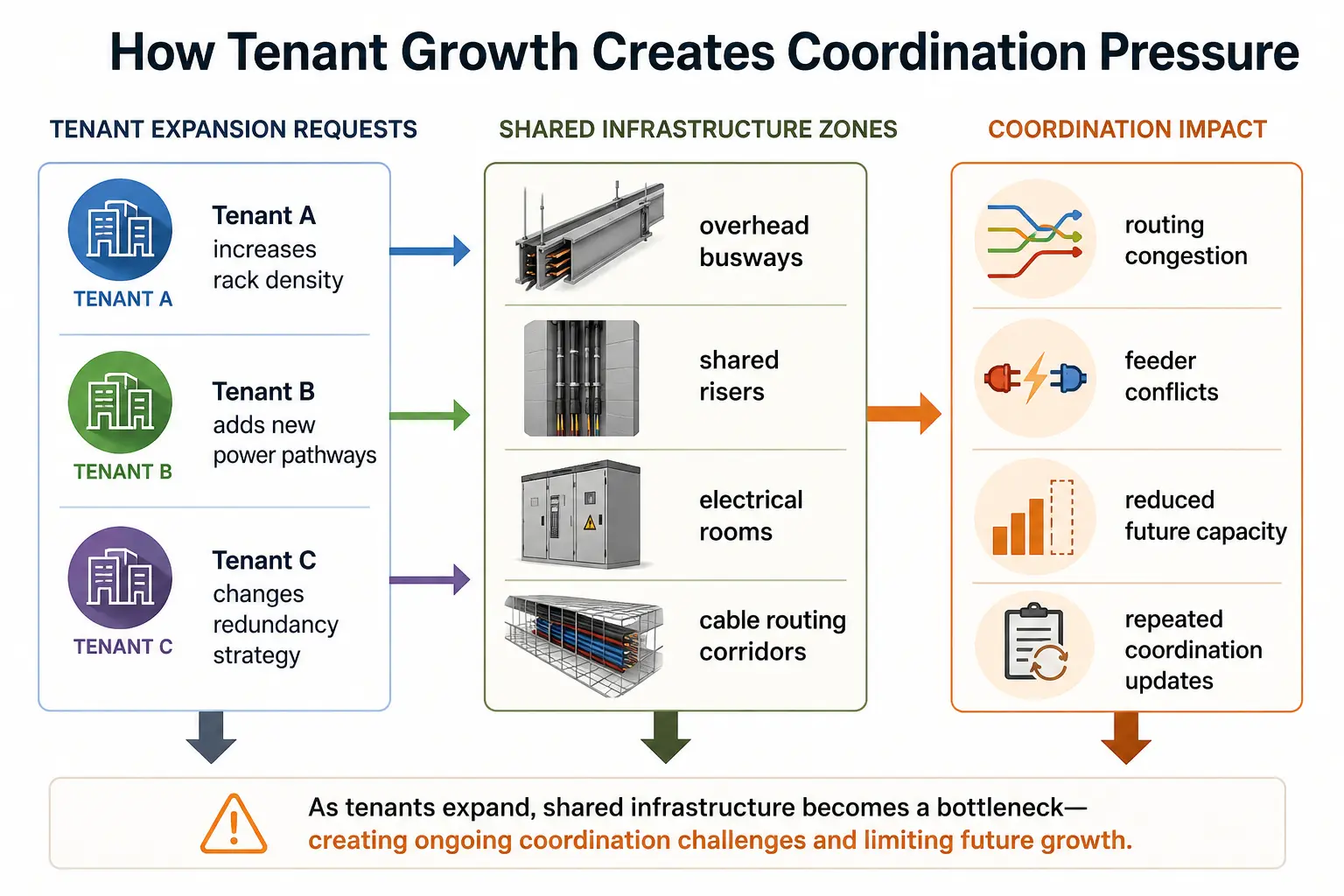
Most coordination problems in multi-tenant data centers happen around shared systems.
Examples include:
- Overhead distribution pathways
- Electrical rooms
- Busway routing
- Shared risers
- Utility entry points
When one tenant changes requirements, the impact often spreads into common infrastructure zones.
That creates downstream coordination conflicts for everyone else.
Why Electrical BIM Models Become Difficult to Maintain
Electrical models in data centers are rarely static.
Tenant requirements evolve throughout the project.
This may include:
- Increased rack density
- Revised power loads
- Modified equipment layouts
- New redundancy requirements
- Phased deployment changes
As revisions increase, maintaining alignment across systems becomes more difficult.
This is where electrical BIM modeling starts breaking down under coordination pressure.
The Biggest Coordination Challenges in Multi-Tenant Facilities
Common coordination issues include:
- Overlapping routing pathways between tenants
- Changing power distribution priorities
- Conflicting expansion requirements
- Limited ceiling space for future routing
- Revisions impacting shared infrastructure
- Inconsistent coordination between phased deployments
These issues become especially difficult inside mission-critical facilities, where downtime risk limits flexibility during construction and operations.
Why Traditional Coordination Workflows Struggle
Most BIM coordination workflows are built around relatively stable system assumptions.
Multi-tenant data centers are not stable environments.
Tenant requirements continue evolving long after early coordination begins.
This creates problems because traditional BIM coordination workflows often rely on:
- Periodic coordination cycles
- Static routing assumptions
- Isolated system reviews
By the time coordination reviews happen, layouts may already have changed again.
How Power Distribution Complexity Changes the Workflow
In data centers, electrical coordination revolves around interconnected systems.
This includes:
- Utility feeds
- Switchgear distribution
- UPS systems
- Branch power pathways
- Tenant-specific redundancy systems
These power distribution systems interact continuously throughout the project.
A routing adjustment for one tenant can affect:
- Feeder pathways
- Clearance zones
- Installation sequencing
- Future expansion capacity
This creates dependency chains that traditional workflows struggle to manage efficiently.
Why Electrical Routing Becomes Unstable
Electrical pathways in multi-tenant data centers rarely remain fixed.
As tenants revise layouts, electrical routing must adapt around:
- Evolving rack configurations
- Changing cooling infrastructure
- New cable density requirements
- Shared overhead space limitations
This creates constant routing pressure across coordination zones.
Without structured routing logic, layouts become increasingly difficult to maintain consistently.
The Difference Between Single-Tenant and Multi-Tenant Coordination
Single-tenant coordination usually follows one operational strategy.
Multi-tenant environments involve multiple overlapping priorities.
One tenant may prioritize:
- Maximum density
Another may prioritize:
- Future expansion flexibility
Another may prioritize:
- Aggressive deployment timelines
The electrical infrastructure must support all of these simultaneously.
That is why data center electrical design becomes far more coordination-sensitive in shared environments.
Why Expansion Planning Creates Ongoing BIM Instability
Many data centers are built in phases.
Tenants expand gradually over time.
This means electrical systems must support:
- Current operational loads
- Future expansion allowances
- Reserved routing space
- Scalable distribution pathways
Without proactive coordination, future tenant expansion creates conflicts with existing infrastructure.

How Coordination Problems Reach Construction
The impact of coordination instability eventually reaches the field.
Typical outcomes include:
- Rerouted feeder pathways
- Installation delays
- Overcrowded ceiling spaces
- Revised prefab assemblies
- Repeated coordination meetings
This slows project execution significantly.
Why Constraint-Aware Coordination Matters More in Data Centers
In dense environments, unrestricted routing creates instability quickly.
Constraint-aware workflows improve coordination by considering:
- Routing hierarchy
- Future capacity allowances
- Tenant separation requirements
- Installation sequencing
- Expansion flexibility
This creates more stable coordination environments across changing project conditions.
Pro Tips for Better Multi-Tenant Data Center Coordination
Reserve routing space for future tenants
Planning only for current layouts creates expansion conflicts later.
Separate tenant-specific and shared infrastructure early
This reduces coordination overlap during revisions.
Validate routing against phased deployment conditions
Current layouts should not block future expansion strategies.
Industry Insight
According to Uptime Institute, scalable electrical infrastructure planning is critical for maintaining operational flexibility and reducing long-term coordination risk in modern data centers.
How GenusysAI Supports Complex Data Center Coordination
GenusysAI focuses on routing and coordination workflows that adapt to evolving infrastructure conditions.
Instead of relying solely on static layouts, it supports:
- Dependency-aware routing
- Coordination-sensitive updates
- Scalable infrastructure planning
- Routing stability across revisions
The goal is not simply generating electrical layouts faster.
It is maintaining coordination reliability as tenant conditions evolve.
Multi-Tenant Data Centers Require Dynamic Coordination
Traditional BIM workflows struggle because multi-tenant environments are constantly changing.
Tenant requirements evolve. Infrastructure adapts. Routing conditions shift continuously.
That is why data center electrical design in multi-tenant facilities requires more than static coordination models.
It requires workflows capable of maintaining stability across constantly evolving electrical systems.
Coordinate Shared Electrical Infrastructure Before Conflicts Scale
If your data center project is struggling with routing conflicts and evolving tenant requirements, the issue may not be the infrastructure itself, but how coordination adapts to change.